
 Español
 English


INTRODUCTION
Located 72 kilometers from the provincial capital, it is accessed via the A-334, which runs right next to its urban center. The Parish Church (16th century) houses a magnificent Cordoban monstrance from the early 17th century. The old Castle is a must-see for history lovers. Belonging to the Duchy of Escalona, it once had four towers, a parade ground, a gunpowder magazine, a courtyard with elegant marble columns, barracks, and a ducal residence. The entire structure is built with the typical local stone. Traditional festivals include San Antón (January 17), featuring delicious migas, San Marcos (April 25), and the Patron Saint Festivities in honor of the Virgen del Rosario, held on the first weekend of August.

Pedro Antonio Guerrero Lorente
Mayor, Hon. Town Council of Armuña de Almanzora
As the Mayor of Armuña de Almanzora, it is an honor for me to welcome all those who choose to discover the wonders of our town through this website.
Visiting the municipality of Armuña de Almanzora is an experience steeped in centuries of history.
All these unique features create a surprising blend capable of offering visitors a wide range of tourist opportunities.
I would like this website to encourage everyone to enjoy and get to know our town, wishing you a pleasant stay that will surely make you want to return.
DISCOVER ARMUÑA DE ALMANZORA
HISTORY
 Regarding the first settlements in the area, some archaeological sites have been discovered that demonstrate the presence of Roman culture in these lands. Later, in medieval times, the Arabic name given to this municipality refers to its fertile farmland, a reality that is still evident today. A noteworthy historical fact is that in the 16th century, this town had 120 houses, although in the Middle Ages it must have had fewer, as it was not yet the seat of a lordship. There are references confirming that around 1560, this town belonged to the Duke of Escalona.
In the past, Armuña had a bread oven, an inn, a tavern and a blacksmith’s shop in the square, as well as three flour mills and one oil mill. Outside the town walls, not far from the cemetery, there was a castle with a large parade ground, four towers, a gunpowder store, a courtyard with marble columns from the Sierra de los Filabres and a beautiful room where the mayors, administrators and clerks lived. It also had dungeons, prisons and silos for storing grain.
The entire construction was made of stone typical of the area, but it is now completely in ruins.
The land was irrigated by the Almanzora River, which had abundant water in winter and enough in summer to irrigate its fertile plain. There was also a plentiful spring, called Paules, which served as a boundary marker for the jurisdiction of this town as well as that of Purchena. Traditionally, the area produced cereals, legumes, beetroot, grapes and oil, as it had numerous olive groves.
Studying such an important period in our history as the Civil War is difficult because the archives containing all the existing documentation were burned. Currently, to consult part of our history, one must go to the Royal Chancery of Granada.
It seems that during the Modern Age, Armuña belonged to the Count of Santisteban and the Marquis of Ariza, although there is hardly any memory of this period in the village.


A BRIEF HISTORY OF ARMUÑA DE ALMANZORA
Armuña is one of the villages in the Almanzora Valley with the richest history per square metre.
Did you know that a Roman woman paid for a banquet and a circus performance to mark the opening of some thermal baths in Almería?
Armuña de Almanzora, Almanzora Valley. Population: 371 (INE 2025), area: 7.72 km², altitude: 629 m, 91 km from the city of Almería. One of the smallest villages in the valley, but with two outlying settlements: Canalito (17 inhabitants) and La Muela (5 inhabitants). Its name derives from the Arabic ‘munya’, meaning ‘orchard’. ‘de Almanzora’ was added by Royal Decree of 2 July 1916 to avoid confusion with other villages named Armuña.
The tablet of Voconia Avita, daughter of Quinto, was found here. An inscription on marble was found behind the canning factories: ‘He built, at his own expense, thermal baths for the Tagilitan Republic of Tagili (Tíjola), hosted a public banquet and circus games, and donated 2,500 denarii for their perpetual upkeep.’ There has been a settlement at La Muela del Ajo since the 6th century BC; an Iberian settlement containing metal slag and Roman pottery.
In the 10th century, they moved down to their present location. A Muslim fortress with towers, walls and a parade ground. Today, all that remains is the Roman cistern reused by the Arabs and a later wall within the municipal cemetery, mentioned by Madoz in 1850. Razed by Don Juan of Austria in 1570. In 1624, nobles from Córdoba donated a monstrance.
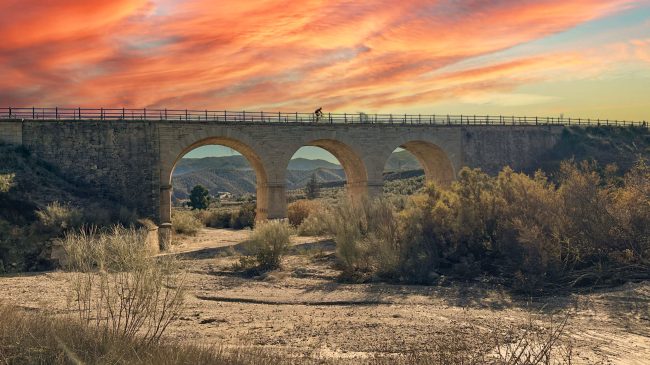
In 1894, the Lorca–Baza railway line reached the area, specifically the Purchena–Serón section: three bridges in Armuña – two metal and one stone – including the Puente de los Tres Ojos on the Rambla de Cela, with three 19th-century arches; one of the ‘30 Wonders of the Valley’ and now a Greenway. Puente de los Secanos at km 91.150 and Puente de la Rambla de Lúcar, 45 metres long and 8.58 metres high.
The church was looted during the Civil War and completely refurbished in 1981. The line was closed by RENFE on 1 January 1985.
Official coat of arms since 2007: divided into a blue field featuring a town on an island set against waves, and a green field with five silver olive blossoms. Blue-white-blue flag with a green circle and five white blossoms. Approved in 1994 but not used until 2007.
GASTRONOMY
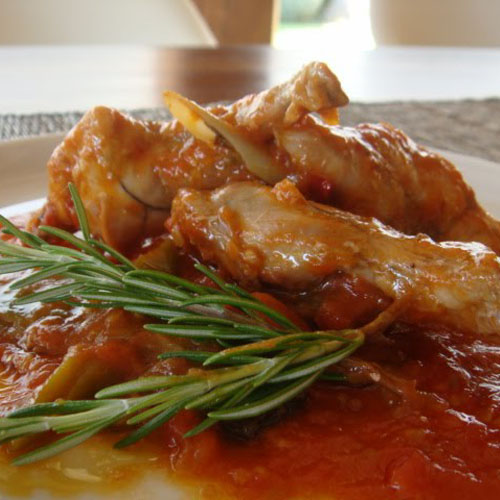
In this municipality, as in the rest of the Alto Almanzora region, typical dishes include migas de harina (breadcrumbs) or migas de pan (breadcrumbs), accompanied by paprika broth, peppers and fried sun-dried tomatoes, fish and tajadas (fried potato slices), all washed down with a good local wine.
Stews and casseroles are also popular, cooked in different ways: with wheat, pumpkin and fennel. In summer, gazpachos and salads with seasonal vegetables grown by the locals in their gardens. Rabbit fritters and porridge with broth are also typical dishes.
Throughout the year, sausages such as black pudding, chorizo, longaniza, blanquillo and other pork products are enjoyed. These are made before Christmas during the famous matanzas (slaughtering of pigs), although they are not made as much anymore. However, it is a ritual in which family and friends usually gather to spend a few days of celebration and work in a tradition that is difficult to lose. Typical pastries include tortas de chicharrones y manteca (pork rind and lard cakes), pan de aceite (olive oil bread), suspiros (meringues) and mantecados (shortbread), and of course hornazos, which are olive oil buns with an egg inside, made for St. Mark’s Day on 25 April.


January
17 January: Saint Anthony’s Day, patron saint of the municipality.
February
Carnival celebrations take place, although they are not very popular nowadays.
2 February: La Candelaria, followed by Holy Week, which is celebrated in March or April, as appropriate.
April
25 April San Marcos.
May – June
In May or June, Corpus Christi is celebrated. In summer, the patron saint festivities are held in honour of Our Lady of the Rosary, and finally we arrive at the big day in Armuña on 7 October, when the day of our patron saint, Our Lady of the Rosary, is celebrated.
Revival of traditional festivals
However, there were many other traditions in Armuña that are being revived, such as the Day of the Cross, the Night of San Juan (Armuña de Almanzora), the Cuadrilla de Ánimas and many others.
These are the most important festivals and traditions, but throughout the year the Town Council organises other cultural activities that are no less important.
ORGANISE YOUR TRIP
WHAT TO SEE
Loading…
<
>
Navigation
<
>
WHERE TO EAT
Loading…
<
>
Navigation
<
>

Armuña de Almanzora Town Hall
Dirección: Constitution Square, 1, 04888 Armuña de Almanzora, Almería
Contacto: 950 42 04 61
Web: http://www.armunadealmanzora.es/

What to do in Armuña de Almanzora?
If you are thinking of taking a different trip to discover beautiful places and charming towns that are not usually well known, a getaway to Armuña de Almanzora is an excellent option. Our town has many options to make and we recommend the ones that are sure to be of your interest.